Washington State, industry groups clash over proposed allowance of A3 refrigerants
The State Building Code Council (SBCC) is considering a code change that could pave the way for European-style HVAC equipment to be installed in homes and businesses


Image: Canva
Washington State wants to lead the country in a transition to more environmentally friendly refrigerants — but HVAC industry groups worry policymakers are moving too fast.
What’s happening: The Washington State Building Code Council (SBCC) is considering a code change that could pave the way for European-style HVAC equipment to be installed in homes and businesses.
- A proposed amendment would allow equipment that operates using A3 refrigerants, which have low global warming potential (GWP) but are highly flammable.
- Because U.S. safety standards don’t yet fully address these refrigerants, industry groups oppose the change. HARDI, AHRI, PHCC and ACCA’s Washington State chapter on Oct. 15 wrote a joint letter to Washington’s governor and state legislature asking them to prevent it.
- The SBCC is scheduled to vote on the matter on Oct. 30.
Catch up quick: When Washington State regulators began adopting the 2024 International Mechanical Code, two engineering consultants proposed allowing “factory-built low-probability equipment using natural hydrocarbon refrigerants (a subset of Group A3 refrigerants)” to be installed, based on safety standards set by the International Electrotechnical Commission rather than UL standards.
- This would allow for A3 refrigerants like R-290 — high-grade propane — which has an extremely low GWP of 3, they noted.
- “Natural refrigerants are needed to reduce global warming and to improve health and wellness, as HFC and HFO refrigerants break down into PFAS forever chemicals in Earth’s atmosphere,” they wrote. “There are many installations of R-290 chillers and heat pumps in Europe currently.”
- They acknowledged that the change would require training for code officials and inspectors to understand safety concerns.
Yes, but: Industry groups worry it could create uncertainty around safety and compliance.
- Using the international standard would allow for 40 times the propane that UL standards currently permit and could conflict with EPA restrictions, the groups wrote in their letter.
- That’s partly because refrigerant stays outdoors in European-style monoblock HVAC systems, whereas in split systems common in North America, refrigerant moves indoors and outdoors, they explained.
Yes, and: Zac Johnson, HARDI’s Senior Policy Lead on HVACR Codes and Rebates, told Homepros that whenever there’s a transition to lower-GWP refrigerants, HARDI has “a few requirements of what needs to be in place, one of those being: There needs to be products that distributors can legally sell,” he said.
- “You can only store, I think, 150 pounds of this refrigerant in an unsprinklered warehouse, or 300 in a sprinklered warehouse,” he added. “Insurance is another question, too.”
- “We’re kind of like: ‘What’s the rush? Why are you doing this now? Just wait until everything is established and well-vetted.’”
The big picture: Washington last year established a task force to study the issue with the stated goal of transitioning to ultra-low GWP natural refrigerants by 2035.
- The associations’ letter suggests that Washington wait and “consider expanded use of A3 refrigerants in the next building-code cycle, after the task force has evaluated the safety and implementation framework.”
- Meanwhile, ACCA has noted that New York is pursuing a “rushed transition” to A3 refrigerants between 2027 and 2034, with California potentially following suit, and that “clean heat coalitions” are pursuing similar policies in at least ten states. The organization opposes a patchwork of state rules and encouraged contractors to chime in on the issue during a virtual town hall meeting on Nov. 17.
What they’re saying: Johnson said a few Washington lawmakers have reached out to him, but he expects that the SBCC “likely will” adopt the amendment.
Representatives for the SBCC and ACCA’s Washington State chapter, as well as the consultants who proposed the amendment, didn’t respond to requests for comment.
Keep reading
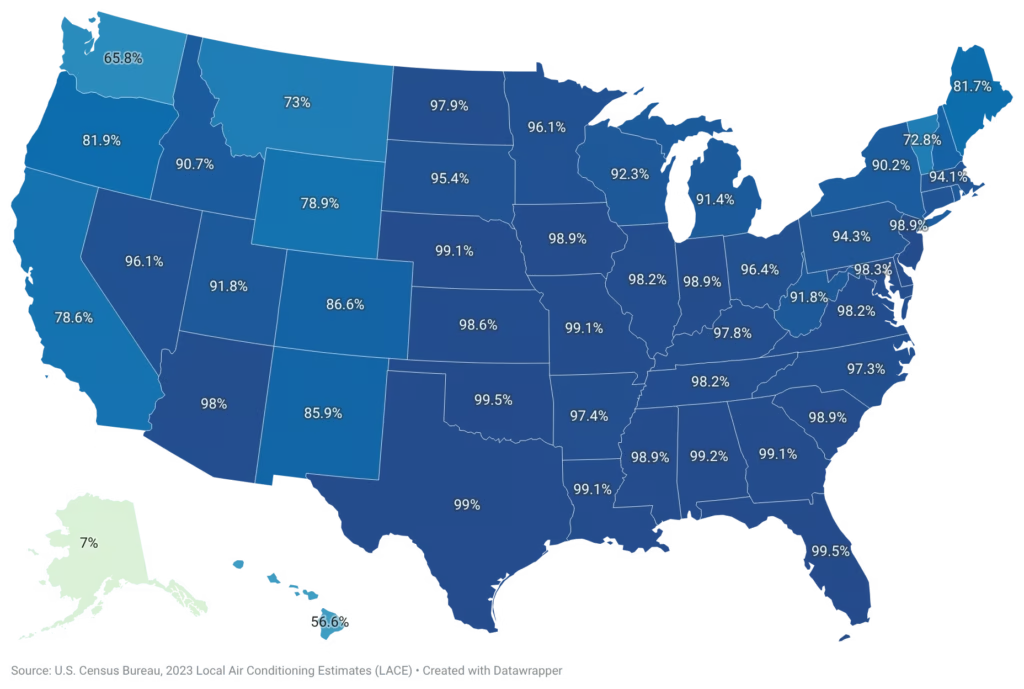
America’s most air-conditioned states
The U.S. Census Bureau in late May launched the 2023 Local Air Conditioning Estimates (LACE) to better understand where households across the country have A/C

ChatGPT’s parent company eyes home services
OpenAI, ChatGPT's parent company, on Thursday rolled out a feature that can find, message, and hire contractors on consumers' behalf
BlackRock, Carhartt, Ford, Google launch skilled trades alliance
“No single company or industry can prepare a country for this opportunity on its own,” executives from the four companies wrote Tuesday
