Heating demand to jump in West, fall in Northeast this winter: EIA
Meanwhile, “We assume temperatures in the Midwest and South are similar to last year,” the agency said


Image: Adobe
The Energy Information Administration’s (EIA) Winter Fuels Outlook, published this month, projects that U.S. heating degree days will be flat this winter (Nov-Mar), compared to last year.
But the regional picture is uneven.
Why it matters: Heating degree days (HDDs) measure how much colder than 65°F a day’s average temperature is — a key proxy for heating demand.
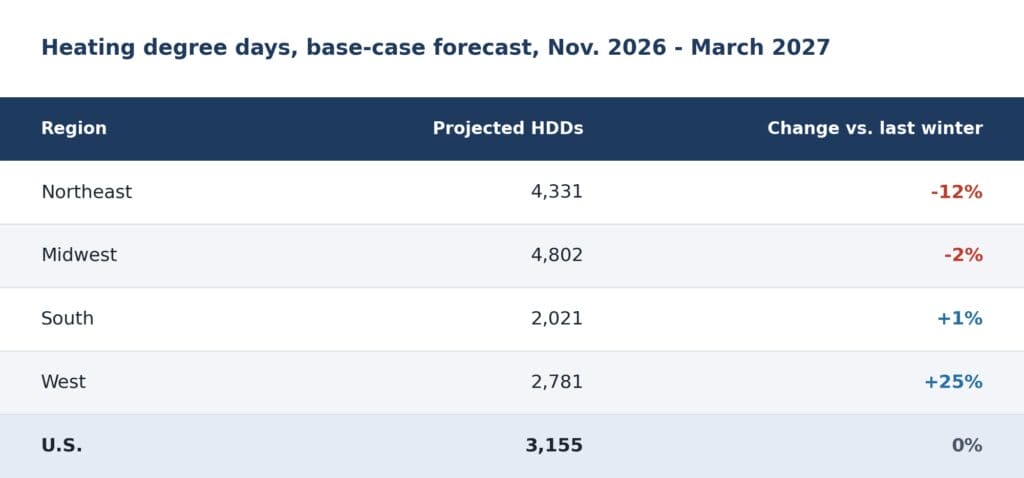
What’s happening: The EIA projects that HDDs will jump 25 percent year-over-year in the West, following an “unusually” warm winter in 2025, while HDDs in the Northeast will fall 12 percent after a “relatively cold” winter last year.
- “We assume temperatures in the Midwest and South are similar to last year,” the EIA wrote.
Zoom in: “For the more than 40 percent of homes that heat mainly with electricity, we expect a 3 percent increase in residential electricity prices and slightly higher consumption will lead to a 4 percent increase in electricity bills,” the report states.
- “The largest forecast increase in electricity spending is in the West, where we expect a 9 percent increase in consumer outlays for electricity because of colder weather,” it adds.
Of note: December through February account for about 68 percent of the projected national HDD total, while November and March together carry the remaining share. January is the peak month in every region except the West.
- Yes, but: A strong El Niño pattern could lead to large temperature variations from the EIA’s forecast, it said.
What’s next: The EIA will update the outlook on November 10.
Go deeper: Full report
Keep reading
Lennox posts 12% drop in residential unit volume, cuts full-year outlook
While the result was weaker than expected, the pace of decline eased compared to earlier this year

Notes from Carrier’s Q4 earnings
February 12, 2024

JobSnap looks to connect contractors directly with homeowners
December 18, 2023