Mapped: 10 years of U.S. cooling demand
Despite a rise in global temperatures, U.S. cooling demand trended downward between 2015 and 2024, according to national weather data

Image: Apollo
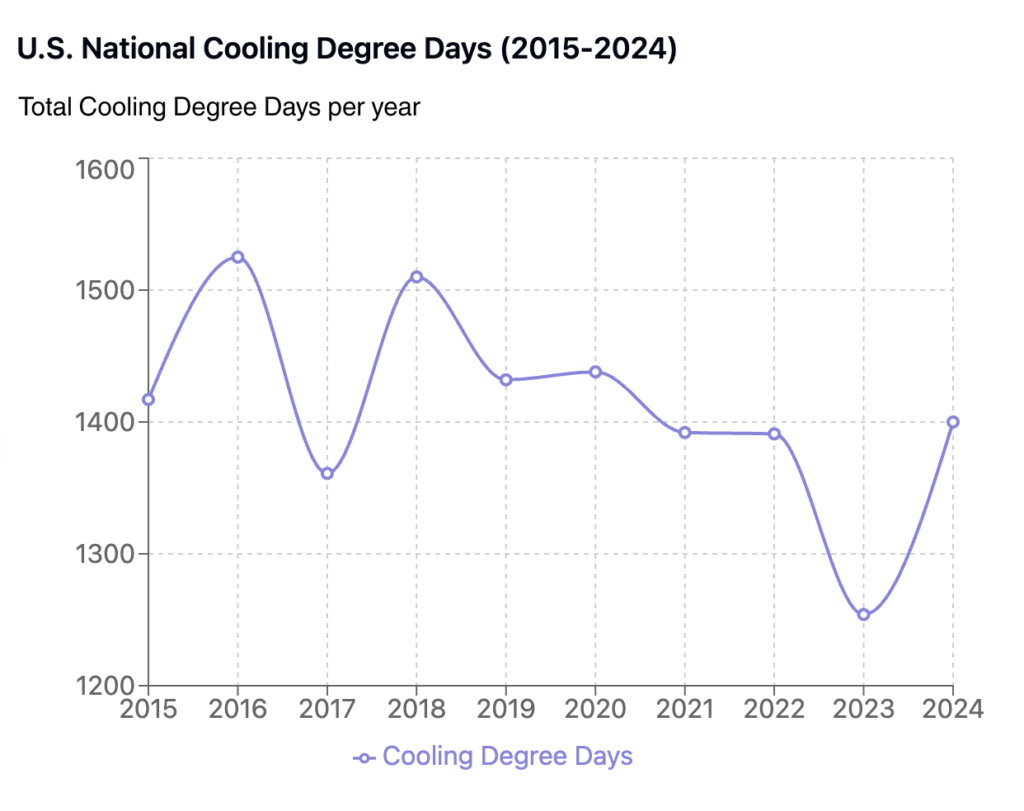
U.S. cooling demand has trended downward over the past 10 years, despite a rise in global temperatures, according to national weather data analyzed by Homepros.
Why it matters: Cooling demand, measured by Cooling Degree Days (CDDs) — the difference between a day’s average temperature and 65 ℉ — serves as a general proxy for HVAC demand, particularly during warmer seasons.
What’s happening: The U.S. has seen an average decrease of nearly 14 CDDs a year since 2015, though with regional variations. Nationwide, cooling demand peaked in 2016 and hit its lowest point in 2023.
- Of note: The years from 2020 to 2023 marked the longest consecutive decline, with nationwide cooling demand dropping a total of 13 percent.
Zoom in: The national trend masks a mixed regional picture.
- The South heated up: Arkansas, Louisiana, Oklahoma, and Texas experienced a warming trend, especially between 2021 and 2023, when cooling demand grew 12 percent.
- The “Heartland,” from North Dakota to Missouri, was the only other region showing an overall increase in cooling demand during the decade.
- The East cooled down: The most dramatic shift occurred along the East Coast, from Delaware to Florida, with cooling demand falling 20 percent between 2019 and 2023 alone.
- Elsewhere across the country, including New England and the Mountain and Pacific states, demand for cooling declined steadily, but not significantly.

See which states make up each region
What’s next: Despite the downward trend, household cooling demand is projected to grow by over 70 percent by 2050, according to the Energy Information Administration.
- “These large future projections are likely under-estimates because they’re based on air temperature (CDD) and therefore don’t account for additional cooling demand due to humidity,” added research group Climate Central.
Editor’s note: Images were generated using data from the National Weather Service.
Keep reading

Water heater shipments rise in September, electric leads in volume
U.S. shipments of both gas and electric residential storage water heaters in September rose year-over-year, according to AHRI data

The cornerstones of a well-optimized Google Business Profile
Build Media’s Kristina Kutsitaru shares opportunities that contractors can seize

Colorado, Michigan launch IRA rebates, bringing active total to nine states
In just the past two months, the number of states with active programs has grown from two to nine