Inside the $40 million ‘Hurricane Lab’ stress testing America’s roofs
How insurers are using full-scale storm simulations to expose roofing failure points — and what it means for contractors

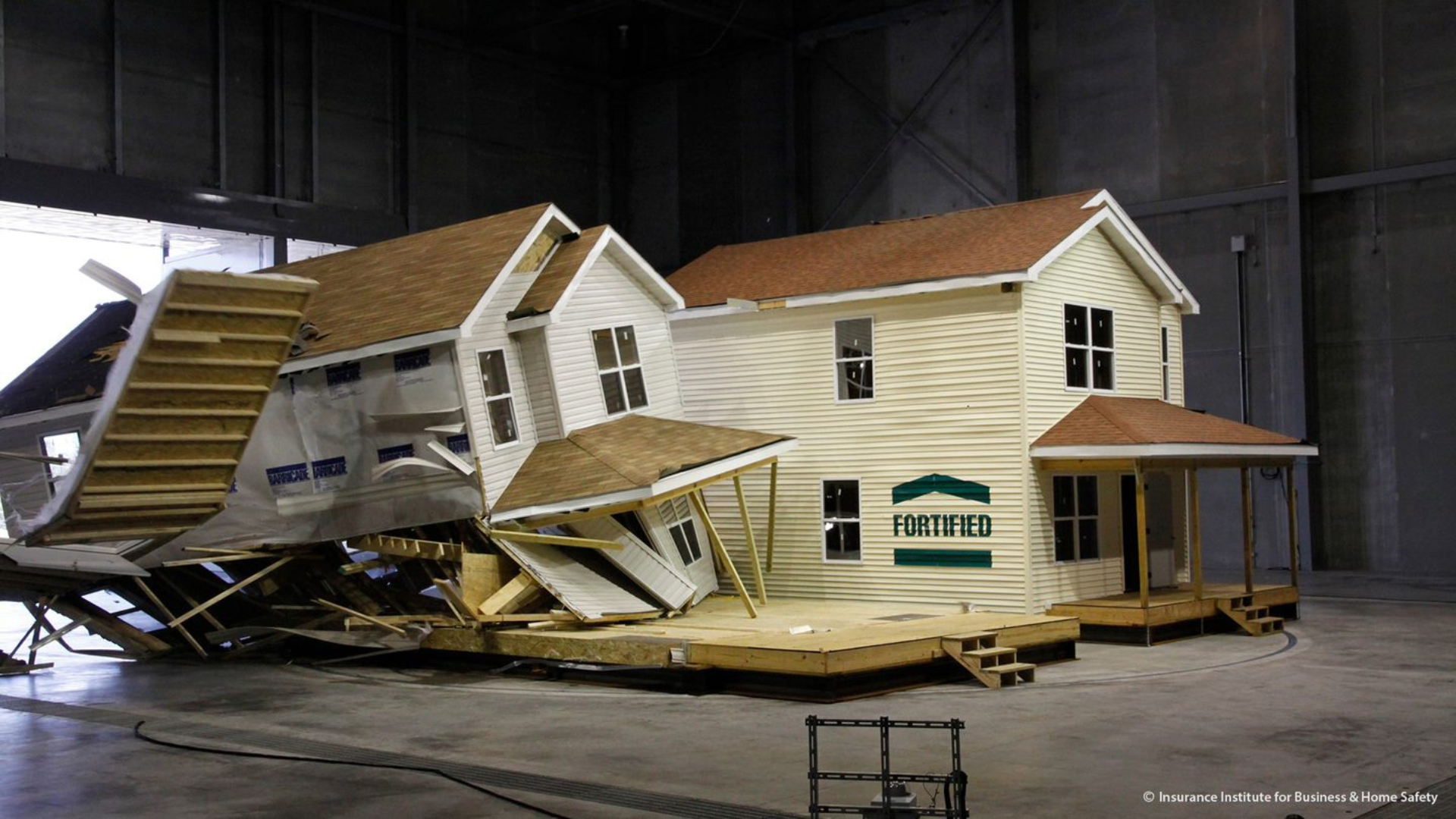
Image: Insurance Institute for Business & Home Safety
In a rural stretch of South Carolina, insurers are quietly running a massive roofing experiment.
Inside a full-scale “hurricane lab,” real homes are being pushed to failure. Not to destroy them, but to understand exactly how roofs behave under extreme stress, which materials hold up best, and what it takes to prevent catastrophic damage — when it can be avoided.
What’s happening: The Insurance Institute of Business & Home Safety (IBHS) is operating the real-life disaster lab to simulate Category 3 hurricane winds and hailstorms on real roofing systems, while simultaneously generating new data on where materials and installations fail first.
- The Richburg, South Carolina-based lab — located roughly 40 miles from Charlotte, North Carolina — is built around a six-story hangar and wind tunnel capable of generating 135 mph winds and firing golf-ball-sized hailstones.
- Built using over $40 million in funding from dozens of insurance companies after Hurricane Katrina, the lab serves as a testing ground to understand how buildings perform under extreme conditions.
Zoom in: Instead of relying on scaled-down models, IBHS engineers build full-scale structures, so its research scientists — with advanced degrees in physics, meteorology, and engineering — can study how damage escalates.
The lab exists because traditional testing methods fall short, according to IBHS.
- “So typically, when wind engineers test structures and pressures on structures, they will do model-scale experiments in smaller wind tunnels, but the thing with model-scale experiments is you lose the details that matter in terms of, say, roofing vulnerabilities,” IBHS research scientist Jake Sorber told Homepros.
- “You can’t really scale an asphalt shingle down to a fifty-to-one model scale and get accurate pressure loads on that, because it’s just too small,” he added.
- In addition to testing asphalt shingles on residential structures, Sorber and his team are also studying how metal and single-ply membranes on commercial roofs behave under stress.
Go deeper: In the past, steel balls were used to replicate hail during testing; however, IBHS says it has discovered a better method after completing over a decade of hailstorm research.
- “A steel ball doesn’t replicate the resistance of a hailstone,” Sorber said.
- IBHS buys shingles off retail shelves, tests them with lab-made hailstones that behave like real hail, and publishes the impact ratings based on their findings.
Zoom out: The lab also studies how external factors, including attached structures and poor installation, can amplify damage and accelerate total roof failure.
- “In the wind space, we know that asphalt shingles are very prone to sealing. And we know that when asphalt shingles unseal, they’re very vulnerable to wind because there is nothing holding them down anymore,” Sorber said.
- “What happens, oftentimes, is once you get to an asphalt shingle roof that’s about ten years old, you start to see a lot of failures on these roofs in hurricanes, and also [in] severe convective storm events,” he added.
The big picture: Insurers are paying out billions in storm-related claims as catastrophe losses continue to rise.
- “What we’re seeing, especially this past year or two, is that we’re getting a lot more losses from storms. Not just because the storms are getting stronger, but because people and more buildings are in harm’s way,” IBHS communications manager Amanda Aycock told Homepros.
- “Roofing is at the center of that risk, because the roof is usually the first point of failure,” she added. “When the roof fails, you get the interior damage.”
Of note: IBHS is funded primarily by insurance companies, and much of its research is used to inform underwriting, improve building practices, and influence how roofing products are designed and installed.
Why it matters: Not all roofing products — even those with the same rating — perform equally under stress: “Not all class-four shingles perform the same way,” Sorber said, adding that two different level-four shingles, for instance, can behave very differently when stressed.
- Meanwhile, IBHS’s hurricane lab is doing more than testing roofs — it’s impacting the rules of risk, as insurance-backed data could influence future standards.
Keep reading

Industry weighs in on EPA’s proposed refrigerant rule change
Representatives for over two dozen HVAC organizations on Monday chimed in on an EPA proposal, which includes nixing a key install deadline
45 minutes with Redwood Services CFO Shaun Hardick
December 21, 2023
Google launches ‘Energy Skilled’ badges: What to know
Google will display 'Energy Skilled' badges on contractors' Business Profiles if at least one technician has earned a certain credential