Carrier, Lennox CEOs on this year’s dynamics, looking ahead
The chief executives at a recent conference took stock of the industry amid a challenging year, particularly for the residential segment


Image: Getty Images
Right next to De Niro: Last week, in New York City, Carrier and Lennox’s CEOs spoke at a Goldman Sachs conference, taking stock of the industry amid a challenging year — particularly for the residential segment — including a refrigerant changeover, falling shipments, and ongoing consumer uncertainty.
Here are highlights from the sessions, per transcripts viewed by Homepros, lightly edited for clarity:
🧭 On the market
David Gitlin, CEO, Carrier: “[HVAC is] pretty much a 15-year replacement business. When you go back to 2010, you started to see a certain recovery. So if you fast-forward to 2025, that recovery in shipments would start to manifest itself in replacements starting in 2025.”
“You also just had a refrigerant change. In history, where you’ve had a refrigerant change, you’ve had some dealers bias toward replacing components versus entire systems, because they’re not as trained and familiar with the new refrigerant. And that history would show that as we train more of our dealers to get more comfortable… you should start to see more of a full replace.”
“The other good news is that we’re probably at a point — no one fully knows — that you would start to see rates come down. [As that happens], you start to see more new home construction, more sales of existing homes, [and with] more dealers trained on the new refrigerant, you start to see that 15-year replacement cycle kick in.”
- Yes, but: “The countervailing force, I would say, is the strength of the consumer. There’s still anxiety out there, and it’s not clear exactly how that will manifest itself as we go into 2026. It’s just a true unknown.”
Alok Maskara, CEO, Lennox: “First of all, over the long term, whether it’s 10 or 20 years, replacements are more than repairs. This year, that didn’t happen. The biggest factor was contractor confidence in the conversion… they didn’t have [R-454B] canisters.”
“Consumer confidence also played a big role. And the consumer confidence was around: ‘I may not be in the home for many years; I’m not sure about my job, maybe I’ll have to move; let’s just repair it even if it’s uneconomic.’ Those factors played a role.”
“The contractor confidence [problem], we’re pretty certain, will go away. Close to 100 percent [of units now] are R-454B, and the canister shortage is behind us. Consumer confidence, we’re going to watch out for.”
- Yes, but: “A lot of this is anecdotal. A lot of it’s in our parts and supplies sales. But I’m pretty confident that this is a blip on a long journey, and the long journey is about more replacement versus repair.”
💸 On costs, pricing
Gitlin: “What we’re expecting for residential here in the Americas, we’ll announce up to a 5 percent [price increase]. We’ll say something like that here in the coming weeks.”
- Yes, but: “If you look at a buying decision for a homeowner [on] a $10,000 unit, if we move price — forget the cost of installation — our product’s a relatively small percent. It’s not going to swing the buying behavior of the ultimate customer.”
- “Has there probably been more repair over replace over the last year? Yes. Is part of it maybe some anxiety in the economy? Perhaps, yes. Is part of it this refrigerant change? Yes. I do not think that is a sustained trend that pricing has gotten so out of whack that you’re going to see everyone limping along with a component change versus a full replace.”
- “You’re going to get to a point where the cost of the old refrigerant is so much that limping along with replacing a component versus the entire system is dis-economic. So I don’t think that it’s a fundamental issue.”
Maskara: “The cost of metal has gone up compared to where we were just a few months ago… We do see secondary tariff impacts [on] many of our costs. So I do fully expect our price increase to happen. I expect others will do the same.”
- Yes, but: “I think the fears about a price war are overblown. I think the fears about repair versus replacement being a long-term trend are overblown. That [HVAC] is nondiscretionary spend remains the case. The fact that the average life of units has continued to come down remains positive.”
Keep reading

Nexstar chair on splitting with private equity, the year ahead
In conversation with Claire Ferrara, Nexstar Network's 2026 chairwoman and president of MN-based Standard Heating & Air Conditioning

Insurers should foot the bill for smart water devices, white paper suggests
Sales of smart water devices “represent a revenue opportunity of more than $160 million by 2030,” according to the paper
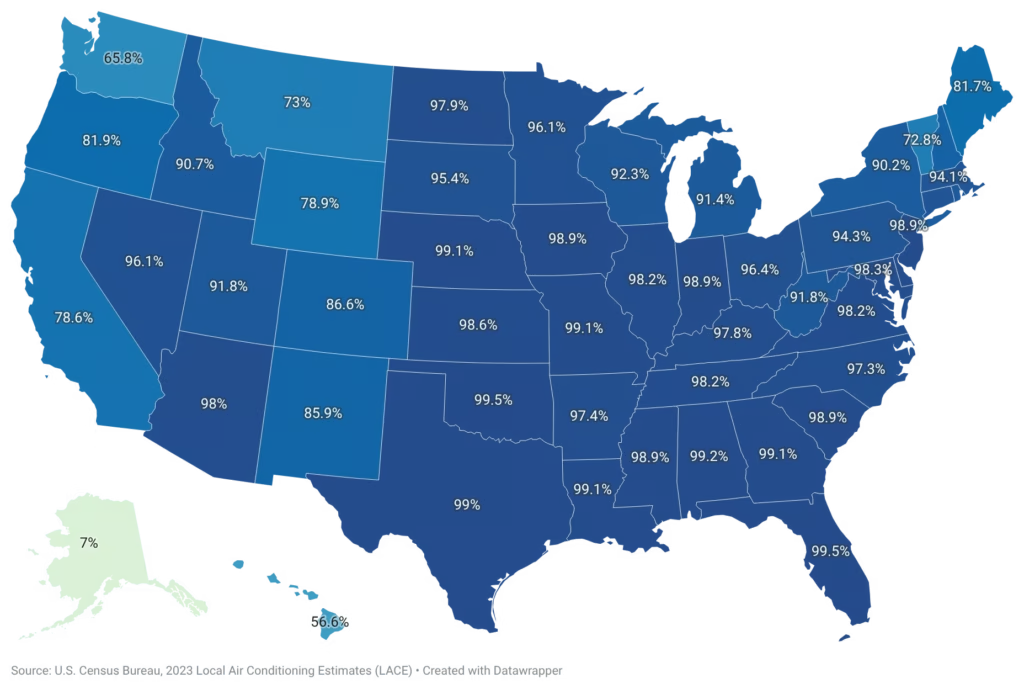
America’s most air-conditioned states
The U.S. Census Bureau in late May launched the 2023 Local Air Conditioning Estimates (LACE) to better understand where households across the country have A/C
